
Machine settings
Examples can include target quantity, coarse and fine flow, pump or piston profile, nozzle timing, container pitch, sensor delays and line speed where those functions exist on the selected configuration.
Liquid filling machine controls
A touchscreen does not by itself define a controlled filling process. The useful specification identifies which physical functions are adjustable, who may change them, what is stored in each recipe, how faults recover and which records the production team needs.
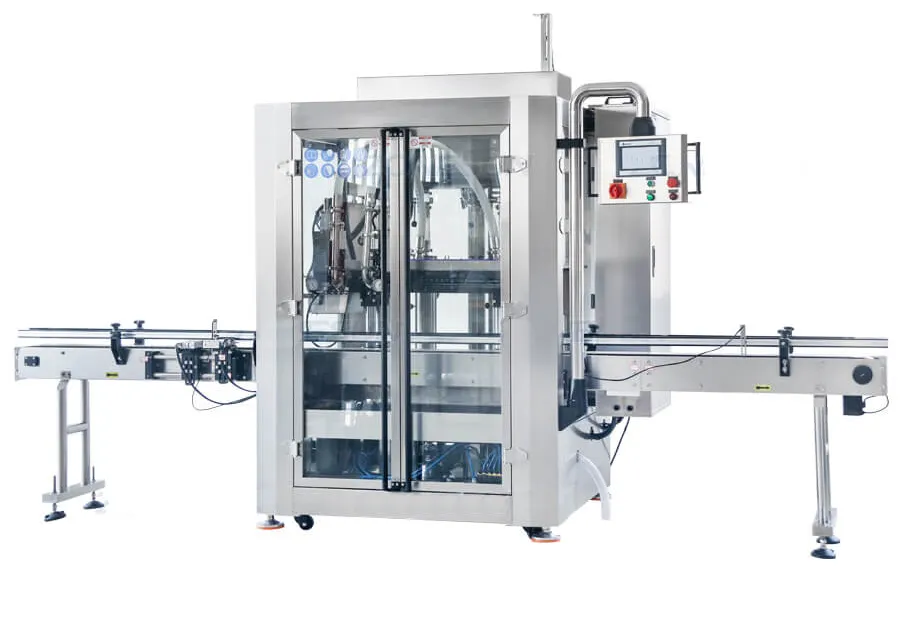
Start with controlled functions
Separate software settings from physical adjustments and from product or pack conditions that remain outside the controller.
Examples can include target quantity, coarse and fine flow, pump or piston profile, nozzle timing, container pitch, sensor delays and line speed where those functions exist on the selected configuration.
Guide positions, nozzle height, tooling, hose or tube choice, valves, star wheels and product-feed hardware may still require mechanical setting and verification even when a recipe is selected.
Product temperature, viscosity, source level, pressure, aeration, container variation and downstream availability affect the result but may not be controlled by the filler.
Recipe design
The exact parameter list depends on the quoted machine. The table is a specification framework, not a claim that every control is standard.
| Control area | Questions to settle | Evidence at trial or acceptance |
|---|---|---|
| Fill target and calibration | What value is entered, in which unit, and how is correction applied to each head? | Measured samples across the required targets, with the approved calibration method recorded. |
| Flow or motion profile | Are there coarse and fine stages, acceleration limits, suck-back, servo positions or pump speeds? | Stable fills without unacceptable foam, splash, air, product damage or cycle delay. |
| Nozzle sequence | What controls open and close timing, diving movement, following motion or delayed withdrawal? | Container clearance, clean cut-off and repeatable behaviour during normal and interrupted cycles. |
| Container sensing | How are missing, doubled, fallen or incorrectly spaced containers detected? | No-bottle-no-fill behaviour, gap tests, blocked-line tests and safe recovery. |
| Product feed | How are level, replenishment, pressure, temperature or source alarms handled? | Stable performance at approved high and low source conditions and during replenishment. |
| Line handshakes | Which ready, run, blocked, fault, stop and reset signals pass between machines? | Controlled stop and restart with upstream and downstream equipment under agreed fault scenarios. |
| Permissions | Which users may run, select recipes, calibrate, change engineering settings or acknowledge alarms? | Role checks using the intended operator, setter, supervisor and maintenance access levels. |
| Records and export | Which counts, alarms, recipe versions, setting changes or sample results are actually required? | Demonstration of the agreed data fields, timestamps, retrieval and retention responsibility. |
Stop and restart logic
Many control weaknesses appear when a line stops between normal cycles rather than during a steady run.
Data with a purpose
More tags do not automatically create better control. Define who uses each record and what action it supports.
Product, pack, version, approval status and associated physical setup or tooling.
Good-pack count, rejects where detected, batch target and planned stop condition where required.
Time, alarm, acknowledgement and recovery information sufficient for the agreed support process.
Record which adjustable values require authorisation and how an approved setting is restored.
Keep measured fill results in the buyer's quality system unless the agreed machine scope explicitly includes capture.
Define signals and ownership at the interfaces with capping, labelling, coding, inspection and site systems.
Questions buyers ask
Confirm the control function, not only the presence of a touchscreen.
No. An HMI can provide settings and calibration functions, but accuracy still depends on the metering hardware, product condition, source stability, nozzle behaviour, container handling and the measurement method used to verify filled packs.
Store only settings needed to reproduce an approved format, such as target quantity, head corrections, flow or motion profile, nozzle sequence, container timing and permitted line speed. Identify any mechanical adjustments and process conditions that the recipe cannot set.
Access should match the production responsibility. Operators may need normal run and recipe selection functions, while calibration, limits, service settings and safety-related configuration are normally reserved for trained authorised roles defined by the user.
Specify data that supports a real decision: recipe identity, counts, alarms, approved changes and agreed interface status. Fill-quality records may remain in a separate quality system unless their capture is explicitly included in the machine scope.
Introduce agreed stops and faults safely, record the state of each container and filling head, then verify that recovery cannot create a missed fill, double fill, drip, unsafe movement or uncontrolled downstream pack.
State the HMI and PLC scope, adjustable functions, recipe capacity, access levels, sensors, alarms, line signals, data interfaces, remote-support boundary, electrical standard, documentation and the tests used to demonstrate each requirement.
Related controls and acceptance guides
Define the controls scope
Include the complete line sequence and representative fault cases so Lancing can identify which functions belong in the machine, line PLC or site system.