
Ideal For
thicker liquid (like gel, hand sanitizer, laundry detergent, shampoo etc.
Automatic filling machines
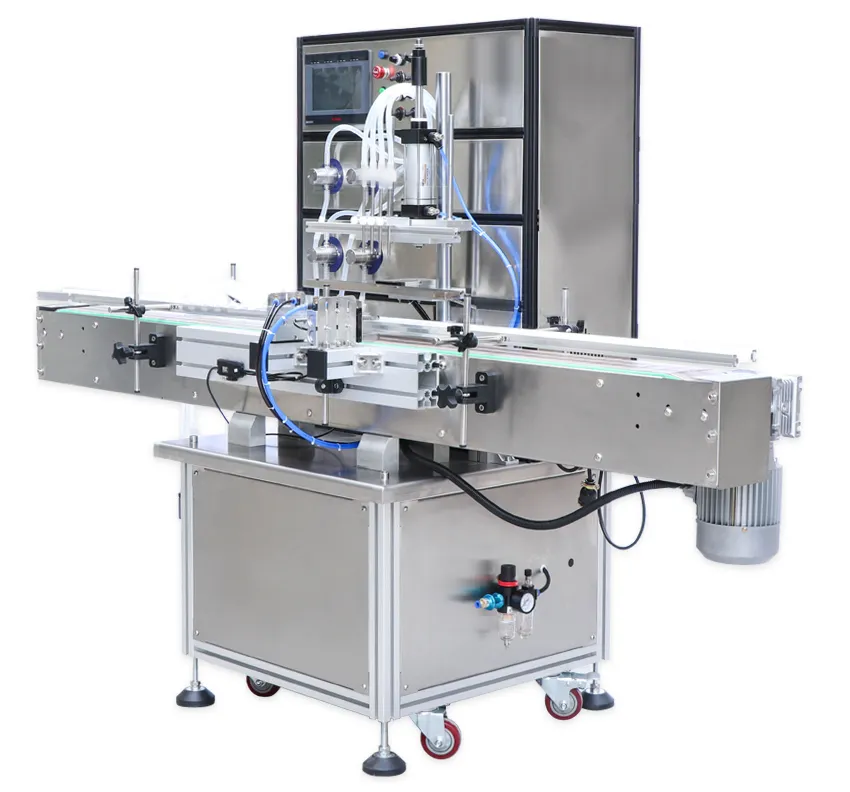
Equipped with a gear pump, this liquid filling machine can work automatically. The machine can fill about 30 bottles/min (at 5L). Each filling nozzle of this machine can be controlled separately, additionally the 40L/min large flow rate makes it suitable to fill both free flowing and thicker liquid (like gel, hand sanitizer, laundry detergent, shampoo etc.) Lancing fully automatic machines are available in a variety of configurations to suit most applications. Equipped with four filling heads can be incorporated together with product tanks, diving nozzles, shut-off valves and bottle gating.
Key features
thicker liquid (like gel, hand sanitizer, laundry detergent, shampoo etc.
2, 4, 6 or 8 head
1000ml-25000ml
high speed fillers ideal for 5L, 10L and 25L bottles and cans (but will fill down to 1L)
+/-1%
Anti-drip function Diving Nozzles
Technical information
Performance varies by product, container and setup. Ask for a timed trial or specification review.
| Ideal For | thicker liquid (like gel, hand sanitizer, laundry detergent, shampoo etc. |
|---|---|
| Head Configurations | 2, 4, 6 or 8 head |
| Fill Range | 1000ml-25000ml |
| Maximum Flow | high speed fillers ideal for 5L, 10L and 25L bottles and cans (but will fill down to 1L) |
| Accuracy | +/-1% |
| Optional extras | Anti-drip function Diving Nozzles |
Product notes
Gear Pump Filling Machines
Equipped with a gear pump, this liquid filling machine can work automatically. The machine can fill about 30 bottles/min (at 5L). Each filling nozzle of this machine can be controlled separately, additionally the 40L/min large flow rate makes it suitable to fill both free flowing and thicker liquid (like gel, hand sanitizer, laundry detergent, shampoo etc.) Lancing fully automatic machines are available in a variety of configurations to suit most applications. Equipped with four filling heads can be incorporated together with product tanks, diving nozzles, shut-off valves and bottle gating.
These machines are high speed fillers ideal for 5L, 10L and 25L bottles and cans (but will fill down to 1L). With prices starting at under £10,000 the Gear Pump Filler is excellent value More advanced systems can also include in-feed and out-feed tables coupled with capping and labelling systems. The machine incorporates an integral conveyor with bottle gating and four filling heads. The heads dive into the bottles making the system suitable for some foamy products. Each filling head is individually adjustable and the main machine parameters are set from an easy to use HMI screen.
Applications
Shampoos, gels, lotions and similar liquids.
Detergents, cleaners, solvents and compatible chemical products.
What is included
Related products
Automatic filling machines
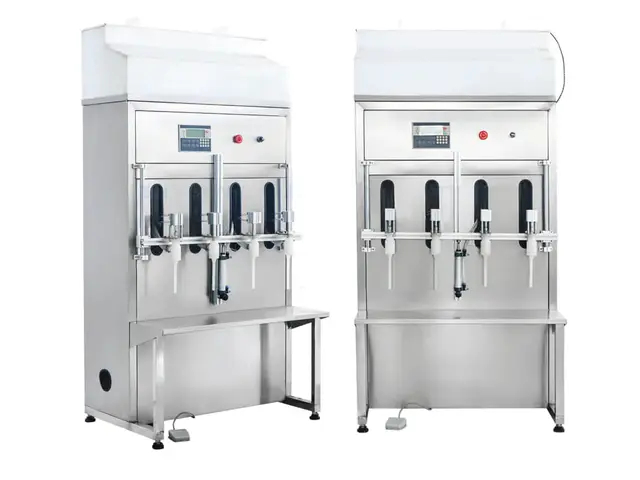
Automatic gravity filler engineered for corrosive liquids like bleach, acids and fertilizers. Non‑metal wetted parts (PP/PTFE/PVC)…
View details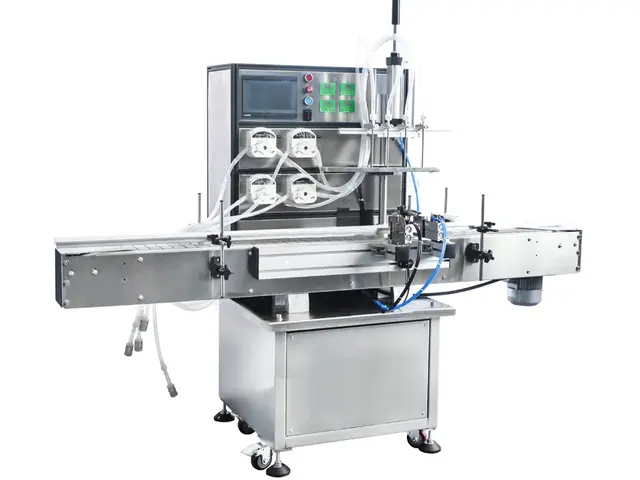
Automatic filling machines
Automatic 4‑head diaphragm‑pump filler for gels, shampoo and detergents. Large 40 L/min flow rate supports ≈30–45 bpm with four…
View details
Automatic filling machines
Servo‑controlled peristaltic filler with touch HMI. Dosing volume is set directly on the screen—no need to time the fill. Four…
View detailsMachine demonstration
The video confirms the container and nozzle arrangement. Pump identity and performance must be fixed in the machine quotation and verified with the production liquid.
Automatic multi-nozzle filling station operating with large orange containers.
Large orange containers travel into position beneath a bank of filling nozzles. The containers are held in a group while the nozzles align with the openings and the automatic filling sequence operates.
Pump and product-path verification
The following points separate the marketing name from the engineering specification that will govern the supplied machine.
| Specification item | What must be stated or tested | Reason |
|---|---|---|
| Pump principle | Gear, diaphragm or other pump type, drive method and how dose is measured or timed | Determines flow behaviour, control, maintenance and suitability for shear-sensitive or particulate products. |
| Wetted path | Pump, seals, valves, hoses, manifolds and nozzle materials | Compatibility applies to the complete product path, not only the main frame or one component. |
| Product supply | IBC, vessel or hopper position, suction lift, feed pressure, hose diameter and refill method | Prevents starvation, cavitation, air entry or changing flow as the source level falls. |
| Container handling | Minimum and maximum pack, opening, base stability, empty and full weight, gates and conveyor guides | Large packs need controlled positioning and safe transfer after the fill. |
| Nozzle function | Shut-off, diving travel, splash or foam control and pressure release after stopping | Controls neck cleanliness, residual drip and cycle time with the actual liquid. |
| Head balance | Individual calibration and consecutive results from every nozzle | Shows whether a combined average is concealing one path that needs adjustment. |
Buyer questions
The final quotation should identify the actual gear-pump model, wetted materials, seals, control method and suitable operating range. The page title and machinery image are not substitutes for the application-specific technical specification.
Provide the liquid name, viscosity range at filling temperature, density, tendency to foam, any suspended solids, chemical compatibility information, source arrangement and required fill range.
The fill quantity, container handling, product replenishment and time to settle or move a heavy filled pack can all limit sustainable output. Test the actual container and complete line sequence.
A diving or bottom-up fill can help control splash or foam for suitable products. The nozzle diameter, travel and withdrawal profile must be tested against the container opening and liquid behaviour.
Prime the complete product path and measure each head separately over consecutive fills. Retain individual results, product conditions and settings before assessing combined line output.
Technical guidance
Confirm the actual pump, product feed and wetted path before acceptance.
Review suction, source level, pressure, air and refill.
Read guideConfirm gears or diaphragms, seals, hoses, valves and nozzles.
Read guideSeparate pump, feed, nozzle and measurement causes.
Read guideRecord product condition, pump configuration and individual results.
Read guide