
Metallic wetted parts
Confirm the specific alloy, surface condition, welds, passivation where applicable and exposure to chlorides, acids, alkalis or cleaning chemistry. Do not assume every stainless grade behaves alike.
Liquid filling machinery guidance
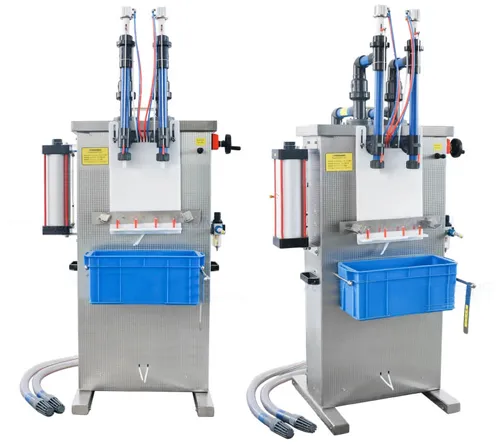
A machine described simply as “stainless steel” still contains seals, hoses, pump elements, valve parts and nozzle components. Compatibility depends on the actual grade or compound, product condition and exposure.
Create a complete wetted-parts schedule
The schedule should identify both product contact and incidental splash exposure where relevant.
List every component that can contact product during normal filling, priming, recirculation, draining, cleaning and foreseeable leakage. Typical items include source connections, hose liners, pump chambers or tubes, valve bodies, seats, seals, diaphragms, O-rings, manifolds, nozzle tips, gaskets, level probes and temporary adapters.
For each item, record the precise material designation supplied by the component manufacturer. Broad terms such as “food grade”, “plastic”, “rubber” or “stainless” are not enough to assess resistance, extractables, swelling, brittleness, adsorption or cleaning compatibility.
Information needed for material review
Review the intended operating envelope, not one nominal condition.
| Input | Detail to provide | Why it matters |
|---|---|---|
| Full formulation or compatibility data | Known ingredients, concentration, pH where relevant, solvents, oils, surfactants, oxidisers and solids. | Different ingredients can attack, swell, extract from or be absorbed by different materials. |
| Operating temperature | Normal, minimum, maximum and any heated-cleaning condition. | Chemical resistance and mechanical properties can change significantly with temperature. |
| Exposure pattern | Continuous contact, intermittent batches, stagnant hold, overnight retention or short flush. | Time and stagnation can change the severity of attack or absorption. |
| Pressure and mechanical duty | Suction, discharge, pulsation, flexing, compression and abrasion. | A chemically resistant material may still be unsuitable for the mechanical duty. |
| Cleaning and sanitising agents | Agent, concentration, temperature, contact time and rinse sequence. | Cleaning can be more aggressive than the product and affects seals, hoses and finishes. |
| Product-quality constraints | Taste, odour, colour carryover, adsorption, shedding, extractables and hygiene needs. | Compatibility includes product quality, not only visible corrosion or leakage. |
Material groups in a filling system
A single incompatible seal can determine the reliability of an otherwise suitable product path.
Confirm the specific alloy, surface condition, welds, passivation where applicable and exposure to chlorides, acids, alkalis or cleaning chemistry. Do not assume every stainless grade behaves alike.
Polymeric pumps, valves or nozzles may be selected for particular corrosive duties. Check temperature, stress cracking, dimensional stability, cleanability and joining methods.
Confirm liner compound, reinforcement, pressure/vacuum rating, bend radius, permeability, extractables, flex life and the effect of repeated cleaning or peristaltic compression.
O-rings, diaphragms and valve seats can swell, harden, soften or absorb product. Compound and cure information may matter as much as the polymer family.
Identify lubricants, thread compounds, adhesives and sensor interfaces that could contact product during a fault or maintenance activity.
Where a coating or lining is proposed, define substrate preparation, continuity, repair, inspection and service limits rather than relying on a colour or trade name alone.
Combine compatibility with cleanability
The product path must remain suitable through cleaning, changeover and maintenance.
Review crevices, dead branches, surface damage, joints, hose tails, valve cavities, drainage and access. A resistant material that traps residue can still be unsuitable for the cleaning objective.
Define inspection criteria, service-life evidence, spare parts, traceability and the method for detecting cracking, swelling, abrasion or surface damage before product quality is affected.
For food applications, the EHEDG hygienic design principles provide recognised context for cleanability and contamination prevention. Applicability to the specific machine and process must still be assessed.
Material-selection questions
Unknown conditions should remain open actions rather than assumed approvals.
No material is universally suitable. Exact alloy, concentration, temperature, chloride content, cleaning chemistry, welds and exposure conditions all matter.
An SDS is essential safety information but may not contain enough compatibility detail for every hose, seal or pump component. Formulation and supplier compatibility data may also be required.
The machine may contact a cleaner at higher temperature or concentration than the product. Seals and hoses that tolerate the product can fail under the cleaning cycle.
List the proposed wetted materials or component references, the product/cleaning conditions used for selection, exclusions, evidence source and any trial or confirmation still required.
A short trial can reveal immediate swelling, leakage, adsorption or flow behaviour, but it may not prove long-term resistance. Define inspection and supplier evidence for longer exposure.
Continue the specification
Prepare a useful enquiry
Include the current SDS, formulation or supplier compatibility data, concentration, temperatures, cleaning agents and required product-contact standard so Lancing can review the wetted path.