
Secure the source condition
Maintain an agreed minimum level, pickup submergence and refill method. Avoid return flows that create a vortex or entrain air near the inlet.
Product-feed troubleshooting
A liquid filling machine loses prime when the product path is no longer completely and stably filled. Common causes include an empty or low source vessel, air entering a suction connection, drain-back through a valve, unsuitable hose routing, a restricted inlet, product gas release or an incomplete changeover prime. Diagnose the system from the source to the nozzle and record when the air appears rather than repeatedly increasing the dose to compensate.
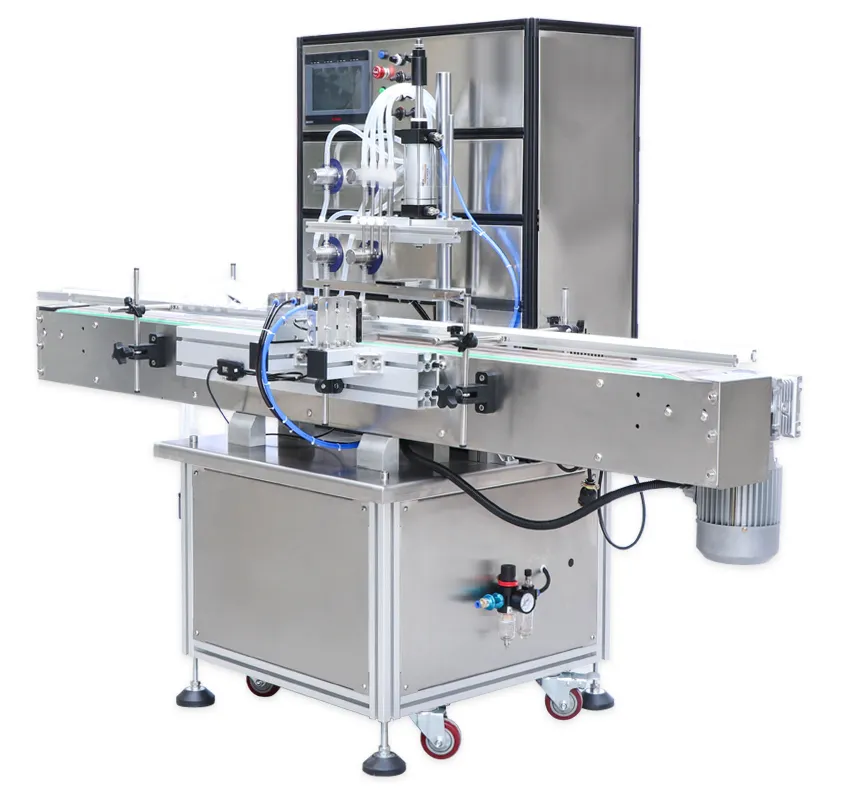
Trace the prime path
The time at which the fault appears is an important diagnostic clue.
| Condition | What may be happening | Check |
|---|---|---|
| Prime is lost while idle | Product drains back, a valve leaks or air migrates through a connection | Observe a controlled stop and restart; inspect valves, hose height and joints. |
| Prime is lost as the vessel empties | Pickup becomes exposed, a vortex forms or inlet head becomes insufficient | Repeat at defined source levels and review pickup location and refill control. |
| Prime is unstable only at high speed | Inlet restriction, product viscosity or lift prevents the meter refilling fully | Compare a slower profile and review hose bore, length, bends and source position. |
| Prime is lost after changeover | A hose, seal, valve or fitting is assembled incorrectly or air remains trapped | Use a documented assembly and priming check before resetting recipe quantities. |
| Prime is lost after replenishment | The refill introduces air or disturbs the pickup and product condition | Observe the refill method and recovery sequence. |
| Prime appears stable but fills vary | A compressible bubble remains, a check valve is inconsistent or the product feed fluctuates | Collect sequential fills and inspect each stage rather than judging only visual flow. |
Correct the cause, then restore the recipe
After the product path is stable, settings should be verified again from a known condition.
Maintain an agreed minimum level, pickup submergence and refill method. Avoid return flows that create a vortex or entrain air near the inlet.
A joint can draw air without leaking product outward. Check hose ends, clamps, seals, valve seats and pickup fittings as one system.
High loops can trap air, unsupported hoses can change shape, and sharp bends can restrict refill. Use a repeatable route suitable for cleaning and changeover.
Identify the first acceptable pack after start or restart and retain the evidence. A stable steady-state result does not prove reliable recovery.
Clear answers
The answer depends on the product, pack and operating conditions, so the relevant variables should be recorded rather than assumed.
Early signs include visible gaps or bubbles in the product path, short or alternating fills, delayed nozzle flow, extra pump movement before discharge, and results that recover after several cycles. These signs should trigger a product-path check. Increasing the recipe quantity before restoring prime can create overfills once the trapped air clears.
A product change can introduce an incompletely filled hose, an incorrectly seated seal or valve, a new hose route, different product viscosity or trapped cleaning liquid and air. A documented reassembly and prime sequence should be completed before recipe tuning. The first fills should be kept separate from steady-run data so recovery is visible.
Yes. A low source level can expose the pickup, reduce inlet head or allow a vortex to reach it, particularly during a fast draw or while product is returned to the vessel. The minimum operating level and refill point should be defined and tested. A larger vessel does not remove the need for controlled pickup conditions.
Check non-return valves for orientation, cleanliness, free movement, seat condition and product compatibility, then inspect hose cuts, clamps, seals and threaded connections. A suction-side joint may admit air without showing an external liquid leak. Use a controlled prime, stop and restart observation rather than relying only on a visual assembly check.
Automatic priming is worth considering when start-up and changeover are frequent, the product path is difficult to observe, controlled recovery is important or manual priming creates inconsistent waste. The function still needs a defined endpoint, safe product destination and acceptance check. It cannot compensate for an inlet leak or unsuitable feed arrangement.
Continue your specification
Use the next guide that matches the unresolved part of the application.
Define source level, pickup, hose, pressure and replenishment conditions.
Separate air already in the product from air introduced by the filling system.
Review pump-feed and shut-off considerations for this technology.
Send the product, container, target quantity and production context so the filling method and trial scope can be reviewed.