
Structure loss
An emulsion, gel or structured liquid may thin, separate or fail to recover after mechanical work.
Product behaviour and pump selection
A product can change when exposed to pump speed, narrow restrictions, recirculation, valves, repeated passes or excessive pressure. The filling trial must compare the product before and after the complete transfer and dosing path under the intended temperature and production duration.
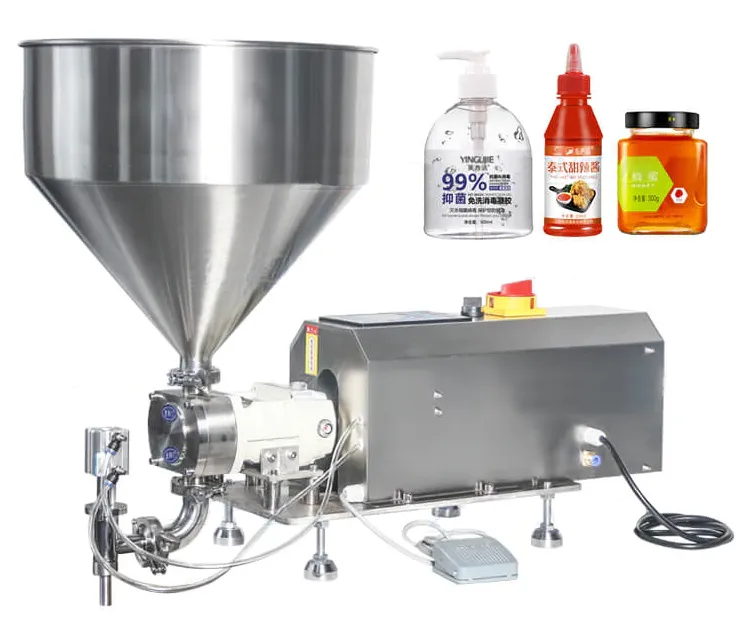
What shear sensitivity means
“Gentle” is not a measurable acceptance criterion. The product owner must define what physical or quality change matters.
An emulsion, gel or structured liquid may thin, separate or fail to recover after mechanical work.
Soft inclusions, fibres or suspended solids may break, bridge, settle or be excluded by a restriction.
High inlet velocity, cavitation or return flow can entrain air and alter measured volume, appearance or stability.
Mechanical work and recirculation may change product temperature and therefore viscosity or quality.
A product recirculated through a pump may experience much more total shear than a single transfer to the nozzle.
Foam, gloss, texture, colour or dispersion can be more relevant than a visible mechanical failure.
Technology comparison
Each method can be suitable in some applications and unsuitable in others. Trial the actual formulation.
| Filling principle | Potential advantage | Shear or product risk to examine | Useful trial evidence |
|---|---|---|---|
| Peristaltic | Product contacts the selected tubing and the path can be replaced for changeover. | Tube compression, rotor speed, internal diameter, pulsation, suction lift and repeated recirculation can affect sensitive products. | Before and after product comparison, tube life, prime, bubbles, dose repeatability and temperature over a sustained run. |
| Piston volumetric | Positive displacement can move viscous product in controlled strokes. | Inlet and outlet valves, acceleration, small ports, piston speed and solids passage may change or exclude product components. | Product structure, valve passage, nozzle restriction, fill profile and minimum and maximum dose samples. |
| Gear pump | Controllable continuous flow can support oils and compatible liquids across broad targets. | Gear meshing, speed, clearances, pressure and dry running can be unsuitable for some delicate structures or particles. | Product condition at intended speed, low-level prime, end pressure, heat, particle integrity and shut-off. |
| Rotor-lobe pump | A large flow path and positive displacement can be useful for viscous or particle-bearing products. | Rotor clearance, speed, pressure, recirculation and downstream restrictions still determine total product work. | Particle passage, viscosity or texture before and after, pressure, temperature, dose control and cleaning. |
| Diaphragm pump | Can transfer a range of compatible liquids using a separated actuation mechanism. | Pulsation, check valves, compressed-air stability, suction conditions and flow restriction can affect the product and cut-off. | Head balance, pulsation, bubbles, prime, product quality, flow stability and pause and restart. |
| Gravity or pressure-time | May minimise pump contact for suitable free-flowing liquids. | Head pressure, level change, valve restriction and product aeration can change rate and repeatability. | High and low source level, temperature, valve response, foam, quantity and sustained output. |
Representative trial
The trial should distinguish machine effects from natural product ageing or batch variation.
Specification checklist
Questions buyers ask
There is no universal lowest-shear pump. Shear depends on pump type, size, speed, pressure, restrictions, recirculation and the product's sensitivity. Compare candidate product paths at the intended operating point using before-and-after product evidence.
Peristaltic filling can provide a simple tube-only product path, but tube compression, rotor speed, bore, suction lift and repeated passes can still affect a sensitive product. The actual tubing and duty must be trialled.
It may, provided the inlet, valves, cylinder, outlet and nozzle pass the particle without bridging, cutting or separating it. Send representative product containing the largest and most fragile approved inclusions for a full-path trial.
Choose checks relevant to the product, such as viscosity, separation, particle distribution, texture, appearance, foam, temperature or another approved quality measure. Compare an unpumped control with filled samples under matched time and temperature conditions.
Lower speed may reduce instantaneous shear, but it can extend residence time or require more recirculation. Determine the combination of speed, pressure and total passes that preserves product quality while meeting the production task.
Provide enough product for priming and sustained operation, plus the real containers. Include the most sensitive formulation, worst approved temperature, largest particles and an agreed unprocessed control sample.
Related product-behaviour guides
Arrange a representative product trial
Include the quality attribute that must be preserved, temperature range, particles, source arrangement, dose and expected run duration so Lancing can propose a useful comparison.