
Keep the batch representative
Where mixing is needed, define its purpose, speed and operating sequence. Excessive agitation can damage particles or introduce air, while insufficient movement can allow separation.
Product-path and trial guidance
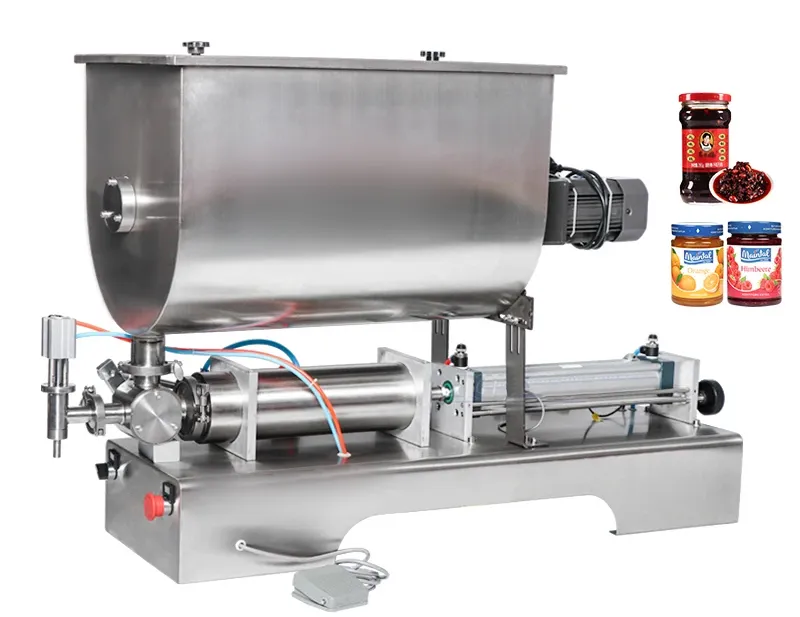
Liquids with particles or suspended solids require a product path that passes the largest credible inclusion without blockage or damage, while the feed system keeps the product representative at the meter. Particle size alone is not enough: shape, hardness, concentration, settling rate, fragility, temperature and the liquid phase all affect the result. Selection should be based on representative product trials and inspection of both quantity and particle distribution.
Describe the complete product
Use production samples because laboratory descriptions can miss particle variation and settling.
| Product characteristic | Why it matters to filling | Evidence to provide |
|---|---|---|
| Largest credible particle | Sets a minimum clearance through pickups, valves, hoses and nozzles | Measured sample range, not only a nominal ingredient size. |
| Shape and hardness | Long, sharp or hard particles can bridge or damage components differently from soft rounded pieces | Photographs, retained samples and an explanation of whether particles must remain intact. |
| Concentration and distribution | Changes the probability of a particle entering each dose and the product resistance through the path | Representative mixed product and expected batch variation. |
| Settling or floating rate | Can make early and late packs contain different solids even when liquid quantity is stable | Observation over the expected production hold and refill period. |
| Fragility | High shear, narrow clearances or valve action may break inclusions | An agreed check of finished product condition. |
| Temperature dependence | Can change the carrier-liquid viscosity and suspension behaviour | Normal and worst-case filling temperatures. |
Treat feed, metering and discharge as one path
Every narrow point and change of direction should be reviewed.
Where mixing is needed, define its purpose, speed and operating sequence. Excessive agitation can damage particles or introduce air, while insufficient movement can allow separation.
Pickup, hose, valves, meter and nozzle should be assessed against the largest credible particle and its orientation. The limiting passage may be hidden inside a valve or fitting.
A fast discharge can separate phases, splash or damage inclusions. A slower or staged profile may help, but must be tested against settling and output requirements.
A correct total mass or volume does not prove that each pack contains a representative share of particles. Agree how solid content or visual distribution will be sampled during a run.
Clear answers
The answer depends on the product, pack and operating conditions, so the relevant variables should be recorded rather than assumed.
Record the largest credible particle, normal size range, shape, hardness or softness, concentration, fragility and whether particles settle or float. Also identify whether the product must preserve whole inclusions. These details should be supported by representative samples because a nominal ingredient size may not describe agglomerates or production variation.
Particles settle when their density and size cause them to move through the carrier liquid faster than the product is circulated or mixed. Long pauses, a large source vessel and low liquid viscosity can make the effect more visible. The production sequence should include stops and replenishment so the trial shows whether distribution remains acceptable.
A peristaltic filler may handle some products with small or soft inclusions when the tubing bore, pump geometry and particle concentration are suitable, but the tubing is compressed during dosing and can become the limiting path. Representative trials should check blockage, particle damage, tube life, dose repeatability and distribution rather than assuming compatibility from pump type alone.
A larger nozzle is not enough when the restriction is in the pickup, hose, pump, piston valve, manifold or another upstream component, or when particles settle before they reach the meter. It also does not correct fragile-particle damage or uneven distribution. The complete product path and feed method should be mapped before changing one visible component.
Inspect the product path after a controlled run and compare finished-pack particles with the incoming sample. Record blockages, partial restrictions, crushed or cut inclusions and changes in distribution. The acceptance method should distinguish normal ingredient variation from damage caused by the machine and include restart checks after any blockage is cleared.
Continue your specification
Use the next guide that matches the unresolved part of the application.
Review a technology often considered where clearances and valve design can be configured for thicker products.
Plan source conditioning, mixing, pickup and replenishment.
Supply enough representative product for priming, running and inspection.
Send the product, container, target quantity and production context so the filling method and trial scope can be reviewed.