
What to check
Check bottle centring, nozzle clearance, fill start and stop, visible product on the neck, and each head separately after the product circuit is fully primed. Repeat the observation after a normal stop and restart.
First-party machinery video library
These Lancing videos show real filling stations, containers, nozzles and product paths. A video can confirm the physical arrangement and operating sequence shown, but final suitability, output and fill performance still depend on the actual liquid, container, machine configuration and agreed trial method.
Use demonstrations as evidence
The machines below use different filling principles and container-handling arrangements.
| Video evidence | What it can show | What still needs confirmation |
|---|---|---|
| Machine arrangement | Number and position of nozzles, conveyor layout, bottle indexing and visible controls. | The final build, options, guarding, utilities and interfaces listed in the quotation. |
| Operating sequence | Container presentation, nozzle movement and the sequence visible during the recorded cycle. | Performance with the intended liquid, full pack range, replenishment and normal stops or restarts. |
| Pack presentation | The container shape and opening used in the demonstration. | Production variation, stability, closure handling and any change parts needed for other packs. |
| Filling result | Visible splash, foam, nozzle tails or drips in the recorded example. | Measured quantity, repeatability, head-to-head variation and an agreed acceptance sample. |
Volumetric filling demonstration
Use the video to understand the station layout; use a representative product trial to verify quantity control and nozzle behaviour.
Check bottle centring, nozzle clearance, fill start and stop, visible product on the neck, and each head separately after the product circuit is fully primed. Repeat the observation after a normal stop and restart.
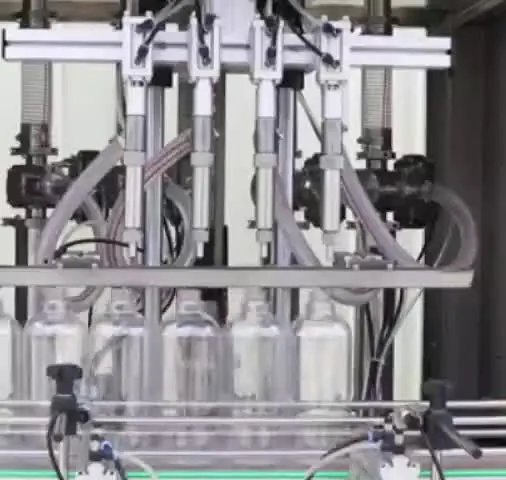
Bottles are indexed beneath four filling nozzles. The nozzles descend to the bottle openings, product is dispensed through the four heads, and the filling station completes the cycle with the bottles retained on the conveyor.
Peristaltic filling demonstration
The video shows the physical product path and nozzle arrangement; tubing, priming and channel calibration must be set for the intended product.
Record the tubing material and size, product source level, priming method, channel settings and individual measured results. Inspect for trapped air, tubing movement and nozzle tails after stopping and restarting.
The machine is shown with four peristaltic pump heads mounted above the conveyor. Tubes run from the pump heads to four nozzles aligned over a group of bottles while the automatic filling station operates.
Pump filling demonstration
The recording shows container presentation and the filling station; the final gear-pump model, wetted path and operating range must be confirmed in the machine specification.
Confirm the product source, pump specification, wetted materials, nozzle movement, container stability and head-to-head results. A larger container trial should include replenishment and movement of the filled pack.
Large orange containers travel into position beneath a bank of filling nozzles. The containers are held in a group while the nozzles align with the openings and the automatic filling sequence operates.
Counter-pressure filling demonstration
The visible cycle does not replace a controlled product trial with the intended liquid, container, temperature, pressure and closure sequence.
Record product and container temperature, pressure conditions, purge and vent sequence, visible foam or loss, closure timing and restart behaviour. The complete acceptance method should count clean, accepted packs.
Containers move through a green rotary indexing section beneath multiple stainless filling heads. The heads engage with the container openings as the counter-pressure filling station advances through its operating sequence.
Prepare the next step
Include the product, fill range, containers, target output, cleaning needs and any capping or labelling interfaces.