
Minimum system
Under the UK government’s packaged-goods summary, a minimum system is based on each package containing at least the displayed quantity. A packer using this approach still needs suitable equipment, checks and records.
Liquid filling machinery guidance
The filler is one part of quantity control. The target, legal packing method, measurement equipment, container tare, density, sampling and corrective-action process all determine whether released packs are compliant and commercially controlled.
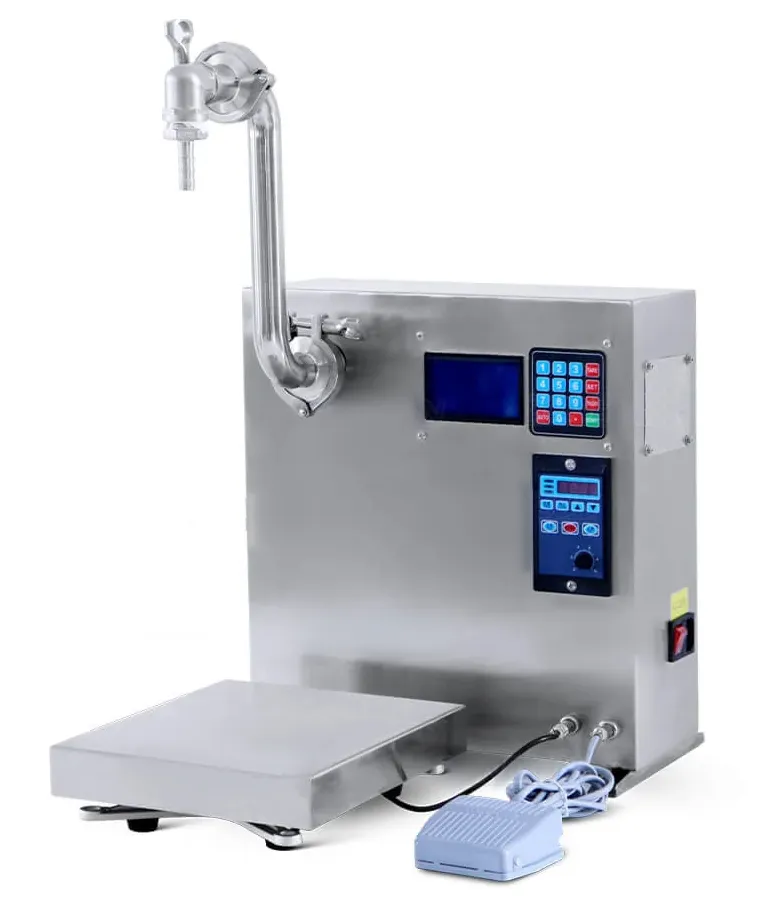
Define what the pack is controlled by
Use the same definitions in the label, recipe, check procedure and acceptance test.
A machine may meter by piston displacement, pump rotation, time, flow measurement or load cell, while finished packs are checked by a different method. Write down the declared quantity, internal target, permitted limits, measurement units and whether the result is net mass, volume at a defined condition or a visual level in the container.
Overfill is not a substitute for process control. An excessively high target can hide variation while increasing giveaway, product loss and downstream problems. The aim is a stable process with a justified target and a documented response when results move.
Build the measurement chain
The measurement system must be capable of detecting the variation the process needs to control.
| Control element | What to define | Common source of error |
|---|---|---|
| Declared and target quantity | Label quantity, internal set point and any action limits. | Confusing nominal quantity with the machine setting or visual fill line. |
| Net quantity method | Individual tare, average tare, gross-minus-tare or direct net weighing. | Container weight variation appearing as fill variation. |
| Volume-by-weight conversion | Product density and the temperature/condition at which it applies. | Assuming one millilitre equals one gram for every liquid. |
| Measuring equipment | Range, resolution, calibration status, location and environmental controls. | Scale resolution or vibration masking small but important changes. |
| Sampling plan | Frequency, randomisation, head coverage, start/restart and batch stages. | Checking only convenient or selected packs. |
| Records and reaction | Individual results, trend, adjustments, rejected product and authorisation. | Recording averages without retaining the data or action taken. |
Minimum and average systems
The chosen control system affects target setting, checks and records.
Under the UK government’s packaged-goods summary, a minimum system is based on each package containing at least the displayed quantity. A packer using this approach still needs suitable equipment, checks and records.
The average system uses batch-average and underfill rules described in current UK guidance. The packer must establish a compliant sampling, equipment and record system; a filling-machine accuracy claim does not by itself demonstrate compliance.
Read the current GOV.UK packaged-goods guidance and packaged-goods regulations guidance, then obtain competent advice for the specific product and market.
Connect the filler to process control
Quantity control continues after commissioning.
Prime and stabilise the process, then use individual results from all relevant heads to establish the recipe. Do not set from one pack.
If results are closely grouped but off target, adjust the centre. If spread is excessive, investigate product, feed, metering, nozzle or measurement causes.
Include start-up, restart, refill, low source level, changeover and end-of-batch conditions where they can affect quantity.
Define who may change the recipe, how changes are recorded and what recheck is required before production resumes.
A reaction plan should identify the product window since the last acceptable check and how packs are held, rechecked or otherwise controlled.
Repeated small corrections can indicate an upstream or mechanical problem. Trend by head, recipe and product condition rather than treating each check in isolation.
Quantity-control questions
The trial plan should match the intended production check method.
No. Machine performance is only one input. The packer’s target, measuring equipment, sampling, records, labelling and reaction system also determine compliance.
Yes where a valid density conversion is used. Density is product- and temperature-dependent, so the value, condition and calculation should be documented.
An average can hide spread, outliers and head-to-head differences. Individual results allow bias, repeatability and trends to be reviewed.
The packer should set a justified frequency based on the legal system, process capability, risk, production pattern and current guidance. There is no universal machine-only answer.
The acceptance and routine-control plan should represent each relevant head. A stable average can conceal one head that is consistently high or low.
Continue the specification
Prepare a useful enquiry
Send the declared quantity, pack-control method, product density information, container tare variation and required sample approach so machine trials can use the same measurement logic.