
Recipe-only changes
Target quantity, pump movement, speed stages, suck-back and nozzle movement may be stored when the hardware is common and the product remains within its proven operating window.
Range and changeover decisions
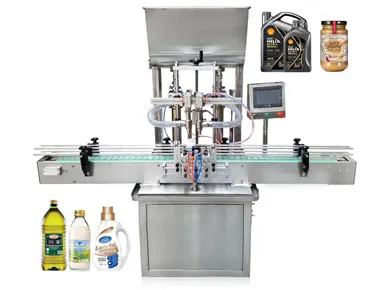
One liquid filling machine can often cover more than one product and bottle, but only when the metering principle, product-contact path, fill range, nozzle access and container handling are suitable for the whole intended range. A recipe change alone cannot correct a physical incompatibility. The safest assessment uses a product-and-pack matrix and trials the combinations that create the greatest filling, cleaning and handling risk.
Build the range matrix
The extremes are more important than the number of stock-keeping units.
| Variable | What can change | Possible consequence |
|---|---|---|
| Product flow behaviour | Viscosity, foam, particles, temperature response and tendency to trap air | Different pump, valve, speed profile, feed arrangement or nozzle may be required. |
| Product compatibility | Contact-material, seal, tubing and cleaning requirements | Dedicated contact parts, a different flow path or separation between products may be needed. |
| Fill quantity | Minimum, maximum and recipe spread | The meter must work accurately and practically across the range, not merely reach both endpoints. |
| Container geometry | Height, width, neck position, stability and opening size | Guides, stops, sensors, nozzles or change parts may need adjustment or replacement. |
| Line interface | Infeed spacing, closure application, labelling and downstream transfers | A filler can cover the dose while the complete line remains incompatible with one format. |
Separate settings from physical changes
Classify each changeover element before the equipment is ordered.
Target quantity, pump movement, speed stages, suck-back and nozzle movement may be stored when the hardware is common and the product remains within its proven operating window.
Guide rails, sensor positions, nozzle height and container stops may be adjustable without replacing components, provided the range and reference points are defined.
Stars, screws, neck locators, nozzles, tubing, valves, seals or product manifolds may be dedicated to a pack or product family.
A second system may be justified where cleaning validation, allergen or chemical segregation, incompatible contact materials, very different flow behaviour or production scheduling creates excessive compromise.
Clear answers
The answer depends on the product, pack and operating conditions, so the relevant variables should be recorded rather than assumed.
Large changes in viscosity, particle size, foaming, aeration, lubricity or chemical compatibility are the strongest reasons to reconsider the metering principle. The question is not whether a product can be made to move once, but whether it can be fed, measured, stopped and cleaned repeatably throughout production without damaging the product or product path.
Changes in base stability, body width, height, neck position, opening diameter and wall stiffness can alter how a bottle is sensed, stopped and centred under a nozzle. A tall narrow bottle may need more support than a short wide jar, while an off-centre neck may need a dedicated locator or nozzle arrangement.
One recipe should represent one verified combination of product, fill target, machine setup and pack conditions. Similar products may share starting settings, but using one recipe for several products can hide differences in prime, speed, shut-off or settling. Separate named recipes and documented changeover checks make deviations easier to detect.
Dedicated product-contact parts should be considered when products are difficult to clean from shared components, incompatible with the same seals or tubing, sensitive to cross-contamination, or operationally risky to mix up during changeover. The decision should include the complete wetted path and storage of cleaned parts, not only the visible nozzle.
Trial the combinations that create the greatest credible risk: the most difficult product at the smallest and largest relevant fills, the least stable container, the smallest opening, the longest required run and the most demanding clean or changeover. A matrix can reduce unnecessary tests, but each omitted combination should be supported by a clear technical reason.
Continue your specification
Use the next guide that matches the unresolved part of the application.
Select the product and pack combinations that prove the intended range.
Define what must be cleaned, replaced, inspected and released between products.
Review stability, sensing, locating and transfer requirements.
Send the product, container, target quantity and production context so the filling method and trial scope can be reviewed.